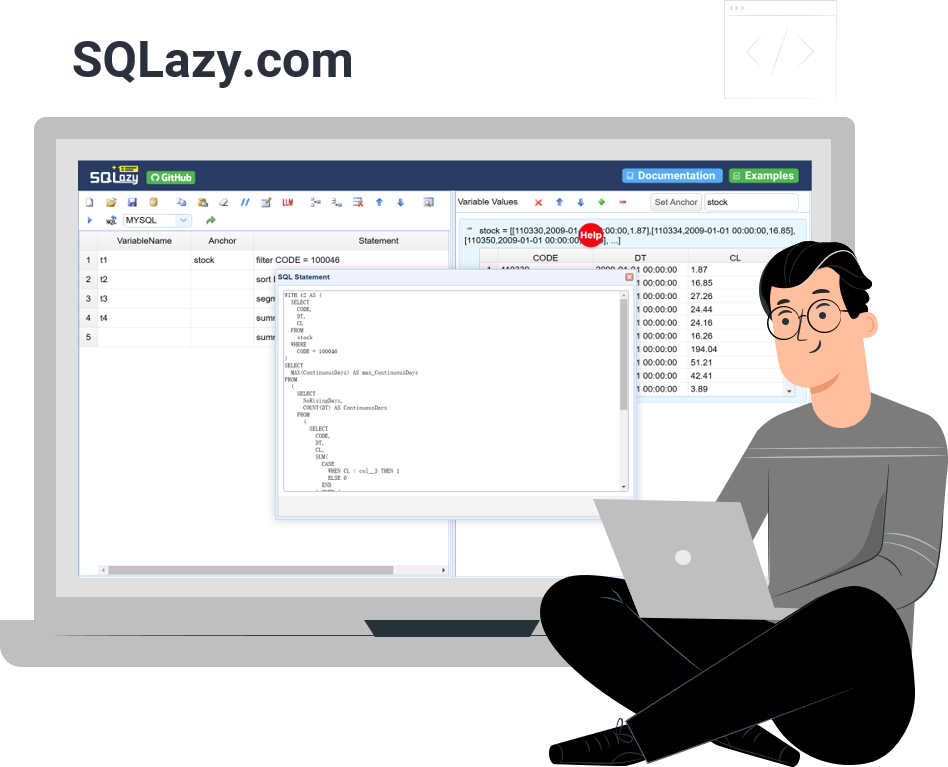
From nested logic to cross-database compatibility, from debugging and troubleshooting to legacy handoffs, do these development headaches sound all too familiar?
Business requirements keep piling on. SQL nesting balloons to seven or eight layers. Logic turns into a tangled mess. Even the author can't read their own code. Execution keeps throwing surprises.
Tracking down errors means breaking subqueries apart layer by layer, running and re-running validation checks. Debugging often takes longer than writing the code – and that's brutally inefficient.
The same business logic needs to be adapted to different syntaxes – MySQL, Oracle, PostgreSQL, and more. It's pure grunt work, and it drives maintenance costs way up.
You inherit the legacy SQL – no comments, no docs, logic so tangled it's unreadable. It feels like defusing an unknown bomb: no one dares touch it, afraid one small change will ripple through the whole system and bring it down.
Data query and extraction tickets pile up, with average response time of 3-5 days. Without real-time data, agile decision-making and fast iteration are out of reach.
Writing SQL should feel this good: freed from tedious, repetitive labor – back to the true nature of building logic.
Logic broken down into steps. Each one single-purpose. Logic stays linear, clear.
Check intermediate results anytime. One click to locate the error source. Debugging cycles shrink.
One set of core logic. Automatically adapted across databases. No manual syntax rewrites.
Logic comes with built-in visual docs and comments. New hires can pick it up with zero communication overhead.
AI handles the boilerplate. The core business logic stays yours.
SQLazy in one sentence – define logic in the standardized natural language, compile it deterministically into native SQL.
Runs entirely on the explicit logic you define – you keep the wheel, start to finish.
A deterministic compiler generates the final SQL. Stable. Reproducible. No uncertainty.
The final output is standard, clean native SQL – embeddable in any database environment, with zero intrusion.
No more nested layers. Complex business logic becomes an intuitive, linear, step-by-step workflow.
One step, one operation. Write it as you think. Read it without peeling back layers.
Complex logic broken into simple steps - no guesswork. Plug and play.
When requirements change, edit only the relevant steps - each is isolated, no ripple effect across the rest.
WITH s2 AS (
    SELECT CODE, DT, CL FROM stock WHERE CODE = 110838
)
SELECT MAX(consecutive up-days) AS longest consecutive up days
FROM (
    SELECT No-gain Flag, COUNT(DT) AS consecutive up-days
    FROM (
        SELECT CODE, DT, CL,
            SUM(CASE WHEN CL < col__3 THEN 1 ELSE 0 END) OVER (
                ORDER BY CASE WHEN DT IS NULL THEN 1 ELSE 0 END, DT ASC
            ) + 1 AS No-gain Flag
        FROM (
            SELECT s2.*, LAG(CL) OVER (
                ORDER BY CASE WHEN DT IS NULL THEN 1 ELSE 0 END, DT ASC
            ) AS col__3
            FROM s2
        ) sub__4
    ) s3
    GROUP BY No-gain Flag
) s4
| Name | Anchor | Statement |
|---|---|---|
| s1 | stock | filter CODE = 110838 |
| s2 | sort DT asc | |
| s3 | segment CL down as NoRisingDays | |
| s4 | summarize DT count as ContinuousDays group NoRisingDays | |
| summarizesummarize ContinuousDays max as max_ContinuousDays |
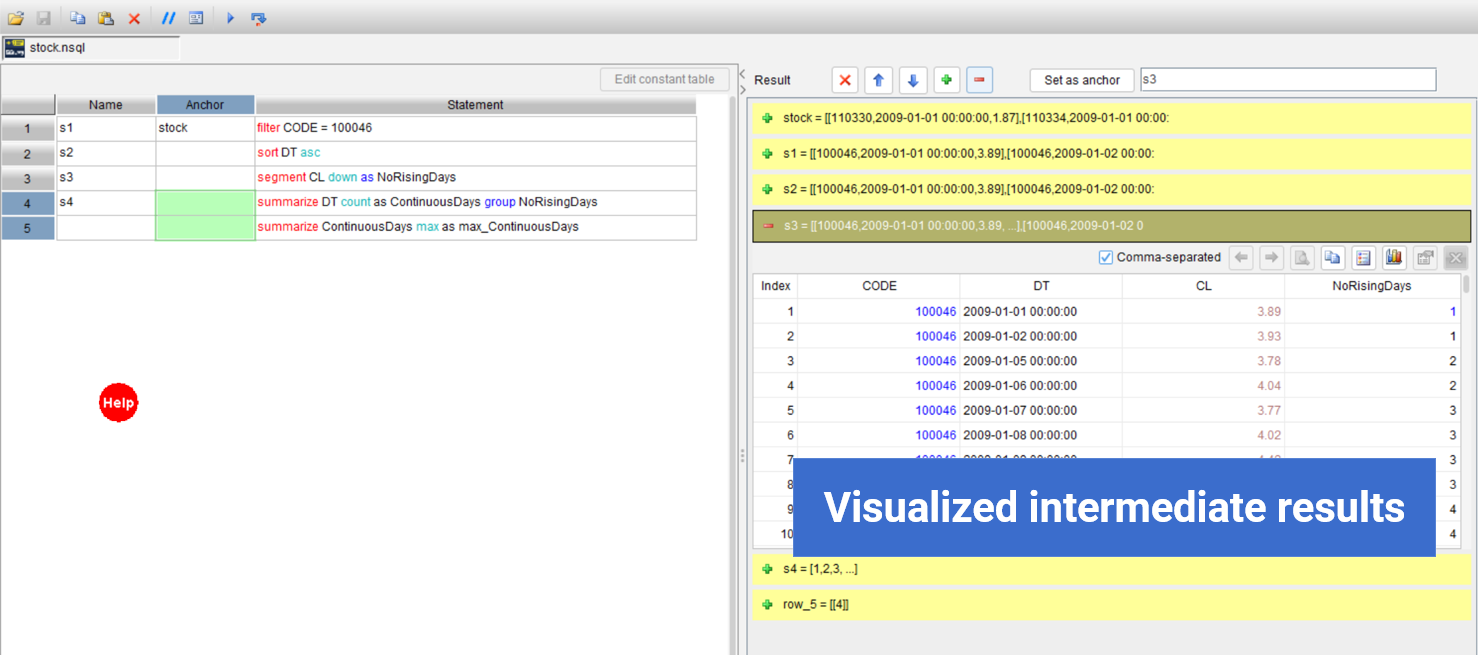
No more manual SQL breakdown, every step's result is checkable - data debugging becomes as clear and controllable as code development.
Click any step to view the full intermediate table – no manual breakdown and execution.
Whether it's a filter condition gone wrong or a flaw in the calculation logic, you can pinpoint the problem on the spot.
Borrowing proven logic from code debugging, this upgrades the old “guess-and-check” process into a visual, traceable, efficient workflow.
No more “thirty minutes to write, an hour to debug”. Just building and optimizing the logic that matters.
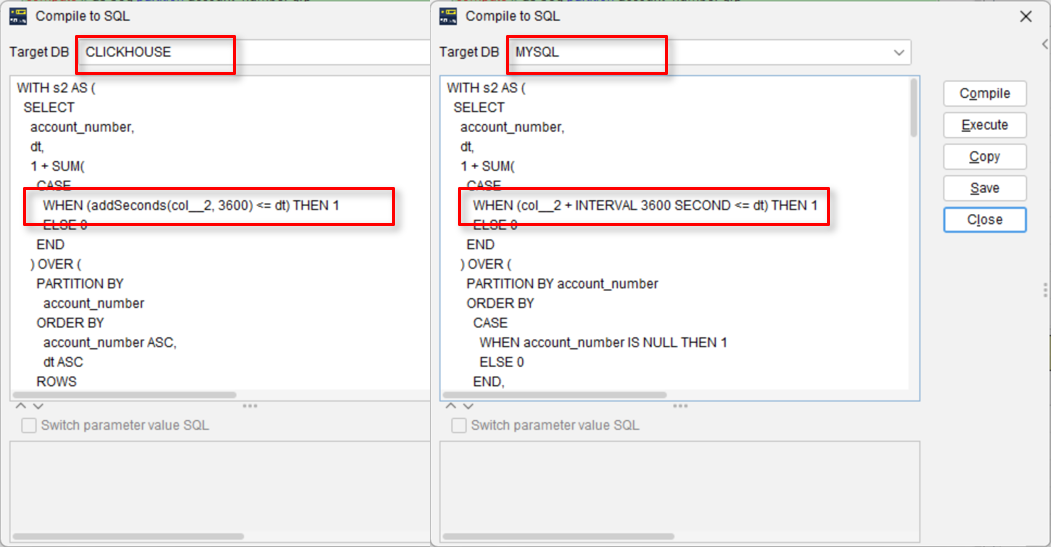
Write logic once. It auto-adapts to every database dialect – seamless cross-platform development.
One logic layer. Touch nothing in the core code. Switch databases in one click.
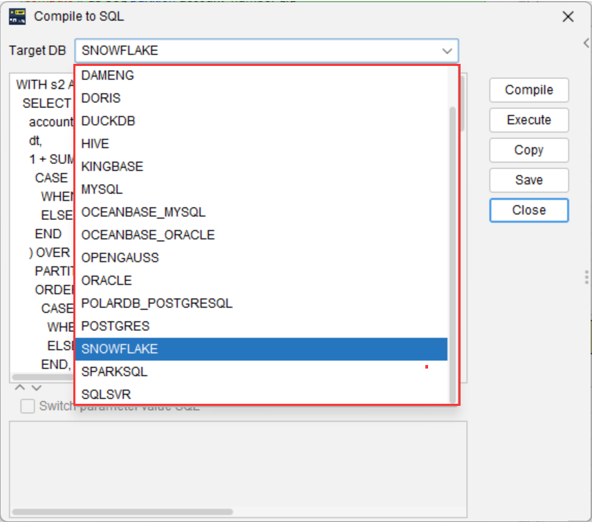
Native support for mainstream databases — MySQL, Oracle, PostgreSQL, and more – plus data warehouse platforms like Hive, Spark, and Snowflake.
Automatically handles function differences, data type conversions, and window function quirks across databases.
No more writing N SQL versions of one business logic just to fit N databases. That era's over.
The steps you write are the living document – every line of logic, clearly visible and fully traceable.
The list of steps is itself a clear description of the computation –- no need to write separate, cumbersome comments. Logic and explanation fuse naturally.
Ad-hoc tickets become a workflow of standardized steps. The historical logic stops being opaque, and reuse means tuning a few key parameters.
Whether it's a new hire takeover or tracing back through the logic later, reading the visualized step-by-step workflow is enough to fully grasp the business logic fast.
Core business logic gets locked into living documents – turnover stops meaning knowledge loss. New hires inherit the best practices directly.
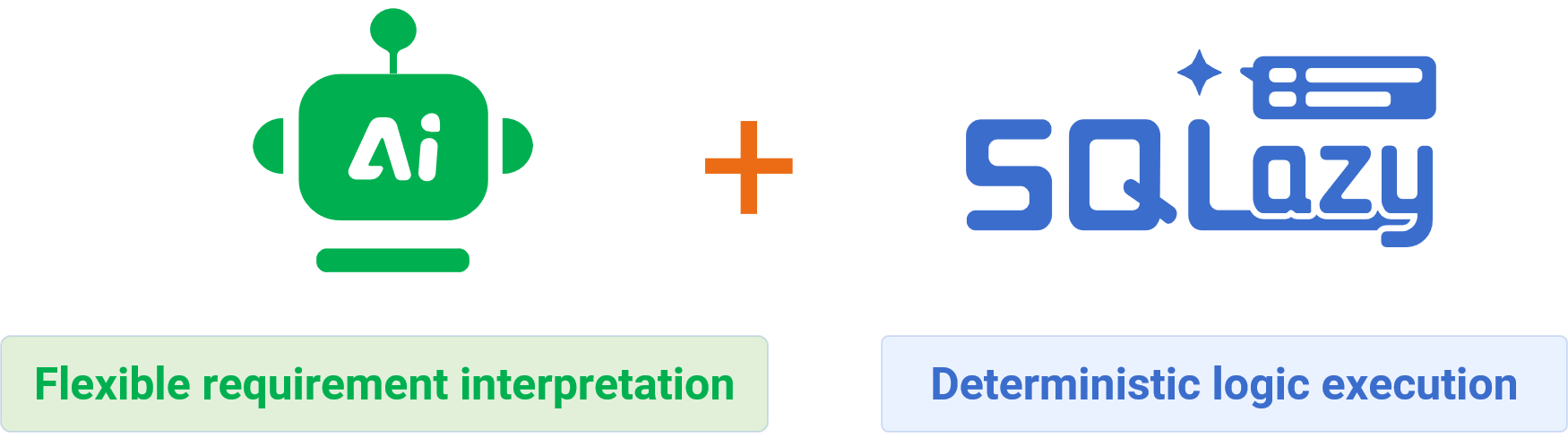
AI is the professional typist – not the decision-maker on business logic. Technology serves thought; it doesn't replace it.
Flexible plain-language step description(e.g.: Get data where CODE is 110838)
AI converts plain language into standardized statements(e.g.: filter (CODE is 110838))
The compiler generates executable SQL.
Works with AI coding tools like Claude or Codex to get the most out of SQLazy.
Understands requirements, clarifies ambiguity, and breaks down business logic – turning fuzzy plain-language requirements into a structured, step-by-step script draft. This is where AI's core strength in handling unstructured information pays off.
Deploy a global spec file at the project root, defining table structure, output format, and hard constraints. AI automatically loads and inherits all rules on startup to ensure that code stays compliant.
Forces AI to output in four steps: capability inventory → requirement breakdown → function matching → code implementation. The reasoning behind every step stays visible – the logic is traceable, human-auditable, and refuses to be a black box.
When requirements are fuzzy, AI proactively asks clarifying questions on boundaries – date range definitions, null-handling rules, grouping-key uniqueness. No default assumptions. Logical deviation gets stopped at the source.
Logic readability: Multi-layer nested structures are hard to read. Logic stays opaque, hidden inside individual developers' coding habits – new hires can't get up to speed quickly.
Debugging and maintenance: Manual breakdown of complex nested subqueries needed. Historical code has no docs to lean on – every iteration and maintenance cycle burns disproportionate time and manpower.
Multi-database compatibility: Cross-database compatibility means manual rewriting – repetitive, inefficient labor. The result depends entirely on individual skill, and stays highly prone to syntax and logic errors.
Logic readability: AI-generated logic runs wild with no fixed standard — output is uncontrollable, and the reasoning process turns into a black box, with no way to trace the logic's source or judge whether it holds up.
Debugging and maintenance: The generation process is a black box – when errors happen, there's no way to trace the cause. Code becomes unmaintainable, closed off to long-term iteration and reuse.
Compatibility and reliability: AI hallucinations exist – output stays inconsistent, cross-database compatibility is weak, and neither the accuracy nor security of business logic can be guaranteed.
Logic readability: Step-by-step logic stays clear and transparent, visualized into standard SQL structure – unified, traceable, and easy for any team member to pick up.
Debugging and maintenance: Every step can be independently validated and traced back – errors get pinpointed exactly. The steps themselves are living document, so maintenance and iteration stay cheap.
Compatibility and reliability: Compile-level validation guarantees 100% correctness. One-click, automatic switching across databases. AI hallucinations are eliminated entirely – business runs on stable ground.
Legacy SQL is deeply nested and its logic is opaque. Once the original developers leave, no one dares touch it — and it becomes a hot potato for system maintenance.
Relying on AI alone yields a static doc. It can't keep pace as the SQL iterates – the doc drifts out of sync with the code and loses its value as a reference.
AI-rewritten SQL easily drifts from the original business rules. Logical consistency can't be guaranteed, and pushing it straight to production carries serious business risk.
From legacy SQL to maintainable asset: The complete workflow
Ingest complex SQL scripts, in multiple dialects, as the source for back-translation.
Break down nested queries and implicit logic, and identify how calculation rules relate to business metrics.
Generate a structured SQLazy script that turns black-box logic into a readable workflow.
Domain experts review the logic to ensure the script matches the business requirements.
Compare old and new outputs on test data to verify logical and data consistency.
Compile the verified script into native SQL for the target database.
Future changes start from the SQLazy script, forming a closed-loop asset that is reusable and traceable.
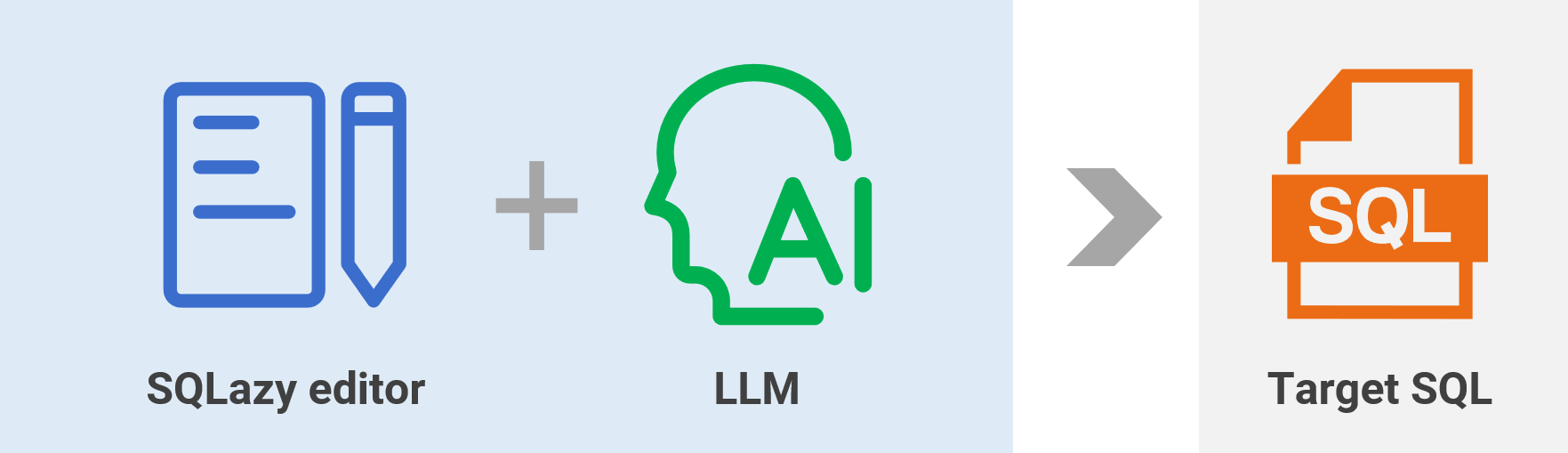
Native SQL only. No embedded code in the production system. Zero architectural risk.
Edit workflow steps visually, with built-in syntax highlighting and smart assistance. Writing scripts takes far less skill to get started.
Click any step to see its intermediate result instantly. Risk-free trial and error for development and debugging.
Compile in real time to native SQL, and switch target databases such as MySQL or PostgreSQL with one click.
Plug in any LLM API key to help standardize your SQL queries.
Runs entirely locally. Data never leaves your internal network. Works fully offline. Enterprise data security is built in at the source.
Connect to your enterprise's in-house LLM service. No call limits for AI code suggestions and optimization. Costs under control, responses faster.
Built-in SPL computing engine. Process million-row datasets locally with ease. Logic verification is far faster than on a traditional database.
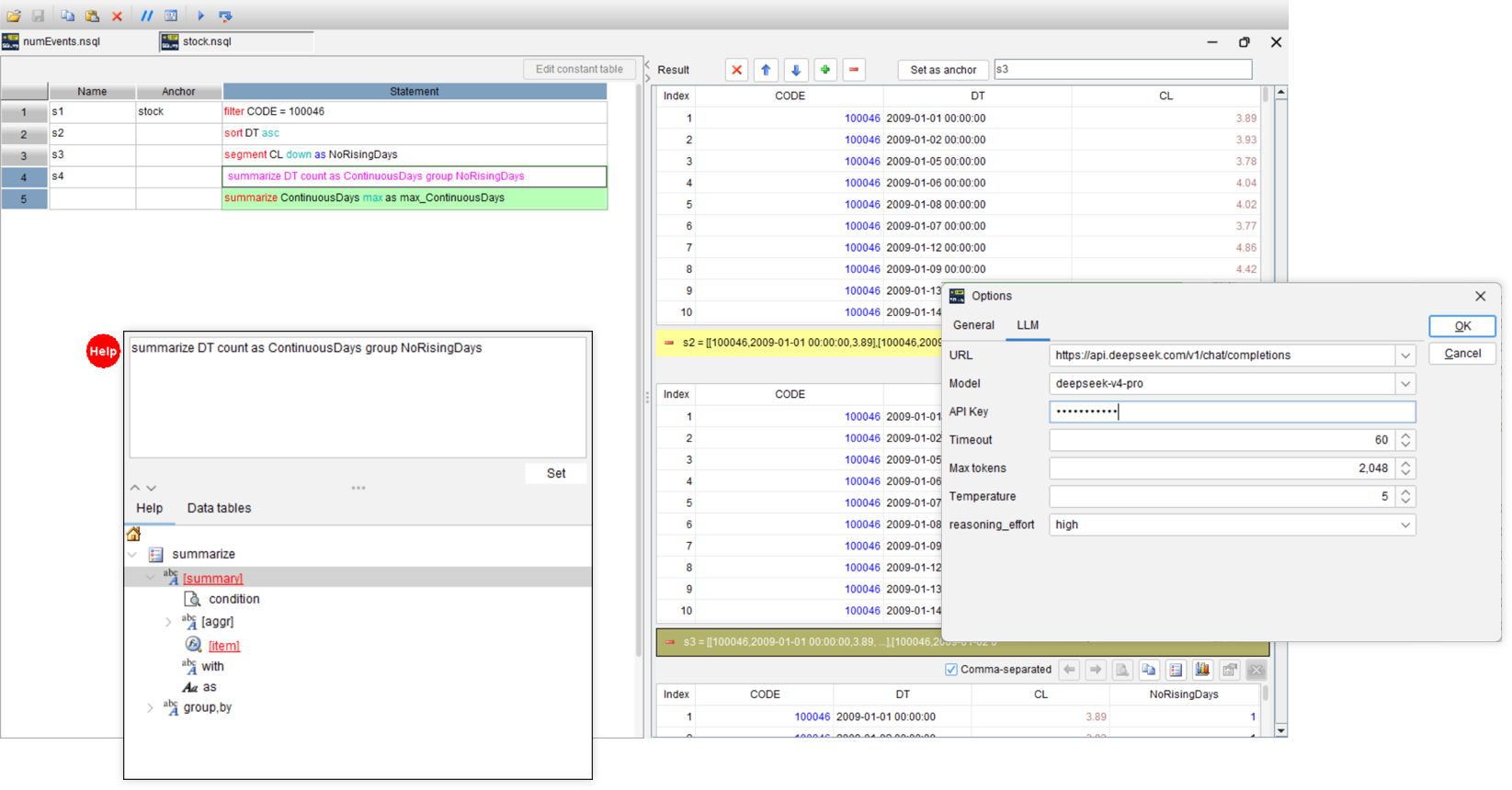
Secure, controlled, efficient SQL development for large enterprises and organizations. Full protection for your data assets and business compliance.
The platform's core services can be deployed inside its internal network, achieving physical isolation and control. External access risk is eliminated at the source, which meets the data localization requirements of heavily regulated sections such as finance and government.
All AI analysis, debugging and compilation of SQL code happens inside the enterprise's internal network. No data is transmitted over the public internet, which removes risks such as data leakage and MITM attacks and keeps core business data secure.
Deeply compatible with mainstream Chinese LLMs, and integrates seamlessly with privately deployed models. Fits the requirements of Xinchuang (IT application innovation) initiative, providing technological self-reliance and security compliance together.
No runtime components are installed in the production system;, no changes to the existing databases and application architecture. Plugs into the current development setup quickly, protects business continuity at zero risk, and makes development more efficient.
Bottlenecks in traditional data ticket handling
Requests pile up in the queue. Average turnaround runs 3-5 days, too slow to support timely decisions.
No one can quickly make sense of a 200-line production SQL query. Handoffs and maintenance become a disaster.
Staff time is eaten up by tedious, repetitive SQL writing, senior talent can't focus on deep analysis and strategic insight.
Fixes the hassle of AI-driven SQL writing and difficulty of debugging it, and responds business needs fast.
Step-by-step debugging ensures correct results and makes auditing easy.
Generate ad-hoc queries fast, without preparing complex test cases for the AI.
Business users can see each step of the logic and validate it directly, creating efficient interaction.
The logic behind each ticket is automatically captured as a reusable asset, so team experience keeps building and improving over time.
From one-off labor to reusable assets: building lasting digital productivity for your team.
Ticket scripts are archived with business tags and metric definitions, turning the results into traceable, auditable digital assets.
For a new request, find a matching historical script, adjust it, and deliver. No reinventing the wheel.
New hires learn standard scripts and metric definitions from the asset library and get up to speed fast, so technical experience passes down seamlessly.
Scripts in the asset library are continuously refined and distilled into team best practices, steadily improving overall efficiency and data quality.
Existing migration approaches
Needs almost no rework and goes live fast. Best suited to TP workloads with simple SQL.
Limited compatibility coverage; weak support for AP workloads with complex syntax. Parsing on the fly makes performance unstable.
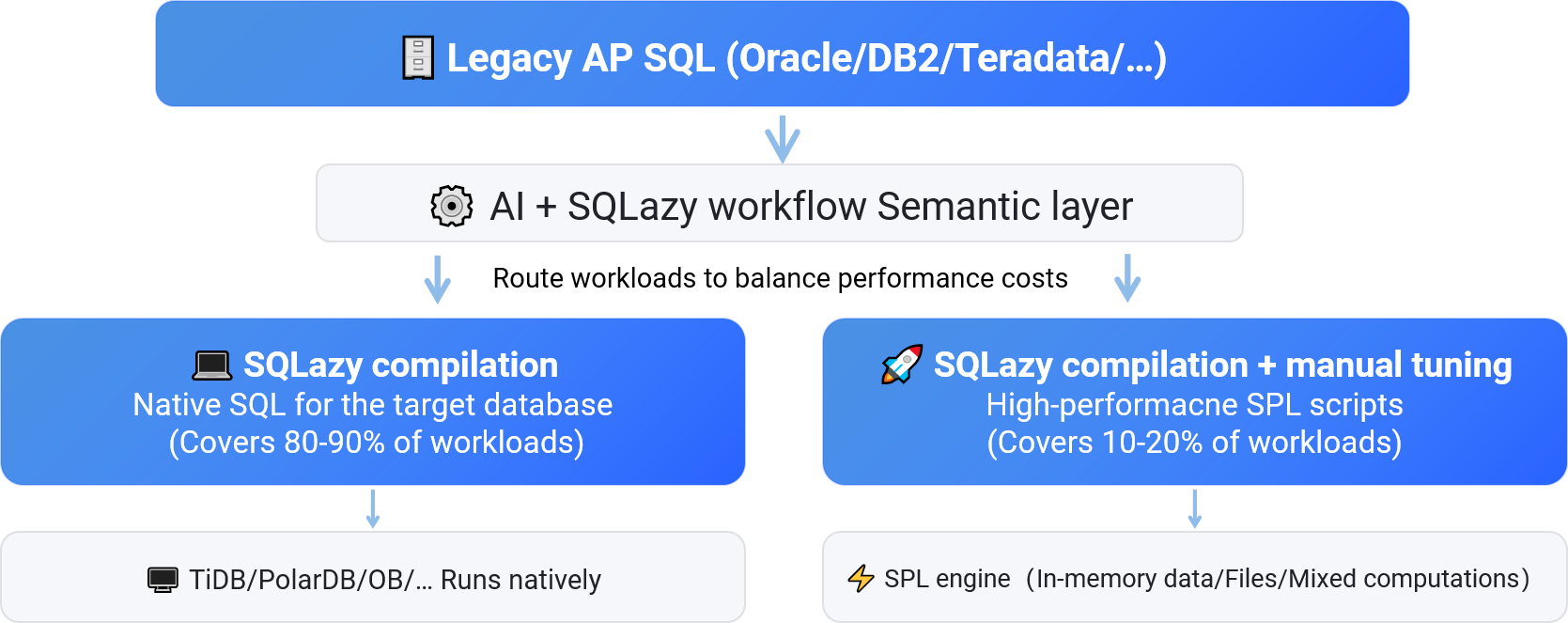
Generates native SQL for the target database, making full use of its capabilities.
LLMs hallucinate, and their SQL is highly error-prone when logic is complex, so human review becomes expensive.
Lower cost. Higher efficiency. 100% logic fidelity.
Use AI to turn complex SQL into structured SPEC scripts.
Run one step at a time and check each result, so the logic is exactly right.
Compile the SPEC script precisely into native SQL for the target database.
Automated testing handles error checking and review, cutting the migration cycle by more than 50%.
The structured steps are easy to debug and audit, which significantly cuts labor costs.
Turn SQL into reusable, maintainable logic assets for enterprises.
Some SQL can suffer a sharp drop in performance after migration, and optimizing the SQL alone doesn't fix it.
SQLazy's core engine, SPL, can implement more high-performance algorithms, delivering a 10x performance gain.
| ID | Date | Invoiced | Amount |
|---|---|---|---|
| AAA | 2023-01 | 0 | 10 |
| AAA | 2023-02 | 0 | 15 |
| AAA | 2023-03 | 1 | 15 |
| AAA | 2023-04 | 0 | 10 |
| AAA | 2023-05 | 0 | 10 |
| AAA | 2023-06 | 1 | 10 |
| BBB | 2022-05 | 0 | 40 |
| BBB | 2022-06 | 1 | 20 |
| BBB | 2022-07 | 0 | 30 |
| BBB | 2022-08 | 1 | 30 |
| ID | Date | Invoiced | Amount |
|---|---|---|---|
| AAA | 2023-03 | 1 | 40 |
| AAA | 2023-06 | 1 | 30 |
| BBB | 2022-06 | 1 | 60 |
| BBB | 2022-08 | 1 | 60 |
Keep only the invoiced rows (invoiced=1). In each row, Amount is the cumulative sum since the last invoice.
| Name | Anchor | Command |
|---|---|---|
| t1 | invoice | sort id,dt desc |
| t2 | compute invoiced cum as grp partition id | |
| t3 | summarize dt max as dt invoiced max as invoiced amount sum as amount group id grp | |
| t4 | derive id dt invoiced amount |
WITH invoice_groups AS (
	SELECT id, dt, invoiced, amount,
    	SUM(invoiced) OVER (PARTITION BY id ORDER BY CASE WHEN id IS NULL THEN 1 ELSE 0 END, id ASC, dt DESC ROWS UNBOUNDED PRECEDING) AS grp
  	FROM invoice
),
aggregated AS (
  	SELECT id, grp, MAX(dt) AS dt, MAX(invoiced) AS invoiced, SUM(amount) AS amount
  	FROM invoice_groups
  	GROUP BY id, grp
)
SELECT id, dt, invoiced, amount
FROM aggregated
ORDER BY id, grp
| account_number | dt | seq |
|---|---|---|
| 19 | 2024-04-03 07:02:02 | 1 |
| 19 | 2024-04-03 07:02:41 | 2 |
| 19 | 2024-04-03 14:58:49 | 1 |
| 19 | 2024-04-03 19:58:49 | 1 |
| 19 | 2024-04-05 14:58:49 | 1 |
| 19 | 2024-04-05 14:59:31 | 2 |
| 19 | 2024-04-17 23:56:13 | 1 |
| 19 | 2024-04-18 00:15:13 | 2 |
| 19 | 2024-04-18 14:56:13 | 1 |
| 19 | 2024-04-19 07:41:55 | 1 |
| 19 | 2024-04-19 07:42:20 | 2 |
| 19 | 2024-04-19 08:41:20 | 3 |
| 20 | 2024-04-17 23:59:13 | 1 |
| 20 | 2024-04-18 07:41:55 | 1 |
| 20 | 2024-04-18 19:41:55 | 1 |
| 20 | 2024-04-18 19:56:55 | 2 |
Generate a sequence number (Seq) based on the first two columns:
| Name | Anchor | Command |
|---|---|---|
| t1 | numEvents | sort account_number asc dt asc |
| t2 | segment condition ((dt[-1] elapse 3600 second) <= dt) partition account_number as grp | |
| t3 | compute # as seq partition account_number grp |
WITH t1 AS (
  SELECT account_number, dt FROM numEvents
),
t2 AS (
  SELECT account_number, dt,
    1 + SUM(CASE WHEN (col__5 + INTERVAL 3600 SECOND <= dt) THEN 1 ELSE 0 END)
      OVER (PARTITION BY account_number ORDER BY account_number ASC, dt ASC) AS grp
  FROM (
    SELECT t1.*,
      LAG(dt) OVER (PARTITION BY account_number ORDER BY account_number ASC, dt ASC) AS col__5
    FROM t1
  ) sub__6
)
SELECT
  ROW_NUMBER() OVER (PARTITION BY account_number, grp ORDER BY account_number ASC, dt ASC) AS seq,
  dt,
  account_number
FROM t2
ORDER BY account_number ASC, dt ASC
| ID | SPLIT | CUST | DATE | AMOUNT |
|---|---|---|---|---|
| ID_1 | SPLIT_YES | A | 2024-05-01 00:00:00 | 100 |
| ID_1 | SPLIT_NO | A | 2024-04-01 00:00:00 | 200 |
| ID_1 | SPLIT_YES | B | 2024-03-01 00:00:00 | 50 |
| ID_2 | SPLIT_YES | A | 2024-05-01 00:00:00 | 50 |
| ID_2 | SPLIT_NO | A | 2024-04-01 00:00:00 | 300 |
| ID_2 | SPLIT_NO | B | 2024-03-01 00:00:00 | 300 |
| ID_3 | SPLIT_YES | B | 2024-04-01 00:00:00 | 90 |
| ID_3 | SPLIT_NO | B | 2024-04-01 00:00:00 | 30 |
| ID_3 | SPLIT_NO | A | 2024-04-01 00:00:00 | 10 |
| ID_3 | SPLIT_NO | A | 2024-03-01 00:00:00 | 10 |
| ID | SPLIT | CUST | DATE | AMOUNT |
|---|---|---|---|---|
| ID_1 | SPLIT_NO | A | 2024-04-01 00:00:00 | 200 |
| ID_1 | SPLIT_YES | A | 2024-05-01 00:00:00 | 150 |
| ID_2 | SPLIT_NO | A | 2024-04-01 00:00:00 | 600 |
| ID_2 | SPLIT_YES | A | 2024-05-01 00:00:00 | 50 |
| ID_3 | SPLIT_NO | A | 2024-04-01 00:00:00 | 20 |
| ID_3 | SPLIT_NO | B | 2024-04-01 00:00:00 | 30 |
| ID_3 | SPLIT_YES | B | 2024-04-01 00:00:00 | 90 |
Partition the table by ID and SPLIT. Within each partition, if any dates are duplicated, partition further by CUST. Then sum the amounts and keep the record with the latest date.
| Name | Anchor | Command |
|---|---|---|
| t2 | splitAcc | rank DT desc dense as rnk partition ID SPLIT |
| t3 | compute if (rnk = 1 then CUST else null) as rnk1 partition ID SPLIT | |
| t4 | compute AMOUNT sum as total_amount rnk1 icount as num_cust partition ID SPLIT | |
| t5 | compute AMOUNT sum as total_cust_amount partition ID SPLIT CUST | |
| t6 | compute if (num_cust = 1 then total_amount else total_cust_amount) as amt | |
| t7 | filter rnk = 1 | |
| derive ID SPLIT CUST DT amt |
WITH ranked AS (
  SELECT
    sub__13.*,
    DENSE_RANK() OVER (PARTITION BY ID, SPLIT ORDER BY DT DESC) AS rnk
  FROM splitAcc sub__13
),
with_totals AS (
  SELECT
    ID, SPLIT, CUST, DT, AMOUNT, rnk,
    CASE WHEN rnk = 1 THEN CUST ELSE NULL END AS rnk1,
    SUM(AMOUNT) OVER (PARTITION BY ID, SPLIT) AS total_amount,
    COUNT(DISTINCT CASE WHEN rnk = 1 THEN CUST ELSE NULL END) OVER (PARTITION BY ID, SPLIT) AS num_cust,
    SUM(AMOUNT) OVER (PARTITION BY ID, SPLIT, CUST) AS total_cust_amount
  FROM ranked
)
SELECT
  ID, SPLIT, CUST, DT,
  CASE WHEN num_cust = 1 THEN total_amount ELSE total_cust_amount END AS amt
FROM with_totals
WHERE rnk = 1
| InvoiceID | Amount | ProjectID |
|---|---|---|
| 1 | 100.0000 | 1 |
| 2 | 100.0000 | 2 |
| 3 | 100.0000 | 3 |
| 4 | 100.0000 | 4 |
| ID | ProjectID | AccountCode |
|---|---|---|
| 1 | 1 | 12345 |
| 2 | 2 | 12345 |
| 3 | 2 | 7890 |
| 4 | 3 | 800 |
| 5 | 3 | 234 |
| 6 | 3 | 987 |
| 7 | 4 | 800 |
| 8 | 4 | 234 |
| 9 | 4 | 987 |
| 10 | 4 | 2579 |
| InvoiceID | Amount | ProjectID | AccountCode | SplitAmount |
|---|---|---|---|---|
| 1 | 100.0 | 1 | 12345 | 100.0 |
| 2 | 100.0 | 2 | 12345 | 50.0 |
| 2 | 100.0 | 2 | 7890 | 50.0 |
| 3 | 100.0 | 3 | 800 | 33.34 |
| 3 | 100.0 | 3 | 234 | 33.33 |
| 3 | 100.0 | 3 | 987 | 33.33 |
| 4 | 100.0 | 4 | 800 | 25.0 |
| 4 | 100.0 | 4 | 234 | 25.0 |
| 4 | 100.0 | 4 | 987 | 25.0 |
| 4 | 100.0 | 4 | 2579 | 25.0 |
Join the two tables, split each project's invoice amount evenly across its accounts, and round each share to two decimal places. Give the last account the remainder so the total stays unchanged.
| Name | Anchor | Command |
|---|---|---|
| t1 | numEvents | join projectid; with invoices; projectid; take invoiceid amount |
| t2 | sort accountcode asc | |
| t3 | compute invoiceid count as cnt, round (amount /cnt, 2) as splitamount partition projectid | |
| t4 | compute splitamount sum as saa, if (# = 1 then round (splitamount + amount - saa,2) else splitamount) as f1 partition projectid | |
| t5 | derive invoiceid amount accountcode projectid f1 as splitamount | |
| t6 | sort invoiceid asc accountcode asc |
WITH joined AS (
  SELECT p.id, p.projectid, p.accountcode, i.invoiceid, i.amount
  FROM projects p
  LEFT JOIN invoices i ON p.projectid = i.projectid
),
with_count AS (
  SELECT *,
    COUNT(invoiceid) OVER (PARTITION BY projectid) AS cnt
  FROM joined
),
with_split AS (
  SELECT *,
    ROUND(amount / cnt, 2) AS splitamount
  FROM with_count
),
with_sum AS (
  SELECT *,
    SUM(splitamount) OVER (PARTITION BY projectid) AS saa
  FROM with_split
),
adjusted AS (
  SELECT *,
    CASE
      WHEN ROW_NUMBER() OVER (PARTITION BY projectid ORDER BY accountcode ASC) = 1
      THEN ROUND(splitamount + amount - saa, 2)
      ELSE splitamount
    END AS f1
  FROM with_sum
)
SELECT invoiceid, amount, accountcode, projectid, f1 AS splitamount
FROM adjusted
ORDER BY invoiceid ASC, accountcode ASC
Get the hang of it in half a day, with your existing habits kept. Learning stays light and efficient.
Fewer than 20 basic operations that carries over your familiar SQL core concepts. Only syntax changes, and it's more intuitive.
Multiple real-world business examples across industries. You don't have to build from scratch to get started.
It doesn't ask you to give up your SQL skills. It offers a more efficient way to organize the logic.
The final output is native SQL that runs directly on your existing databases and BI tools. It's fully compatible with any data platform.
Try it now. No waiting for deployment. We offer multiple ways to fit different use cases.
No sign-up or login needed. Open your browser and start using SQLazy. It's a good fit for quick validation and generating ad hoc queries.
Debug on large local datasets, and connect your organization's in-house LLMs and private knowledge bases, so data processing stays more secure.
Generates native SQL you can copy and paste straight into any query editor, job scheduler, or BI tool.
No intrusion on your existing data architecture, and full respect for how your team works and the tech stack you use. AI becomes an invisible assistant inside your workflow.
Try SQLazy online now at www.sqlazy.com . No signup needed. Every core feature is free to use.
If you have any problems or ideas for improvement, feel free to contact us through SQLazy community forum or by email. We look forward to your feedback.


